
Pressure Gauge vs Pressure Transmitter vs Pressure Switch: Key Differences, Working Principles and Industrial Applications


Pressure Gauge vs Pressure Transmitter vs Pressure Switch: Key Differences, Working Principles and Industrial Applications
Pressure measurement is one of the most important functions in industrial instrumentation. From monitoring water pressure in a pumping station to controlling steam pressure in a boiler, industrial systems depend on reliable pressure measurement to operate efficiently and safely.
However, when selecting an instrument, a common question arises: What is the difference between a pressure gauge, a pressure transmitter and a pressure switch?
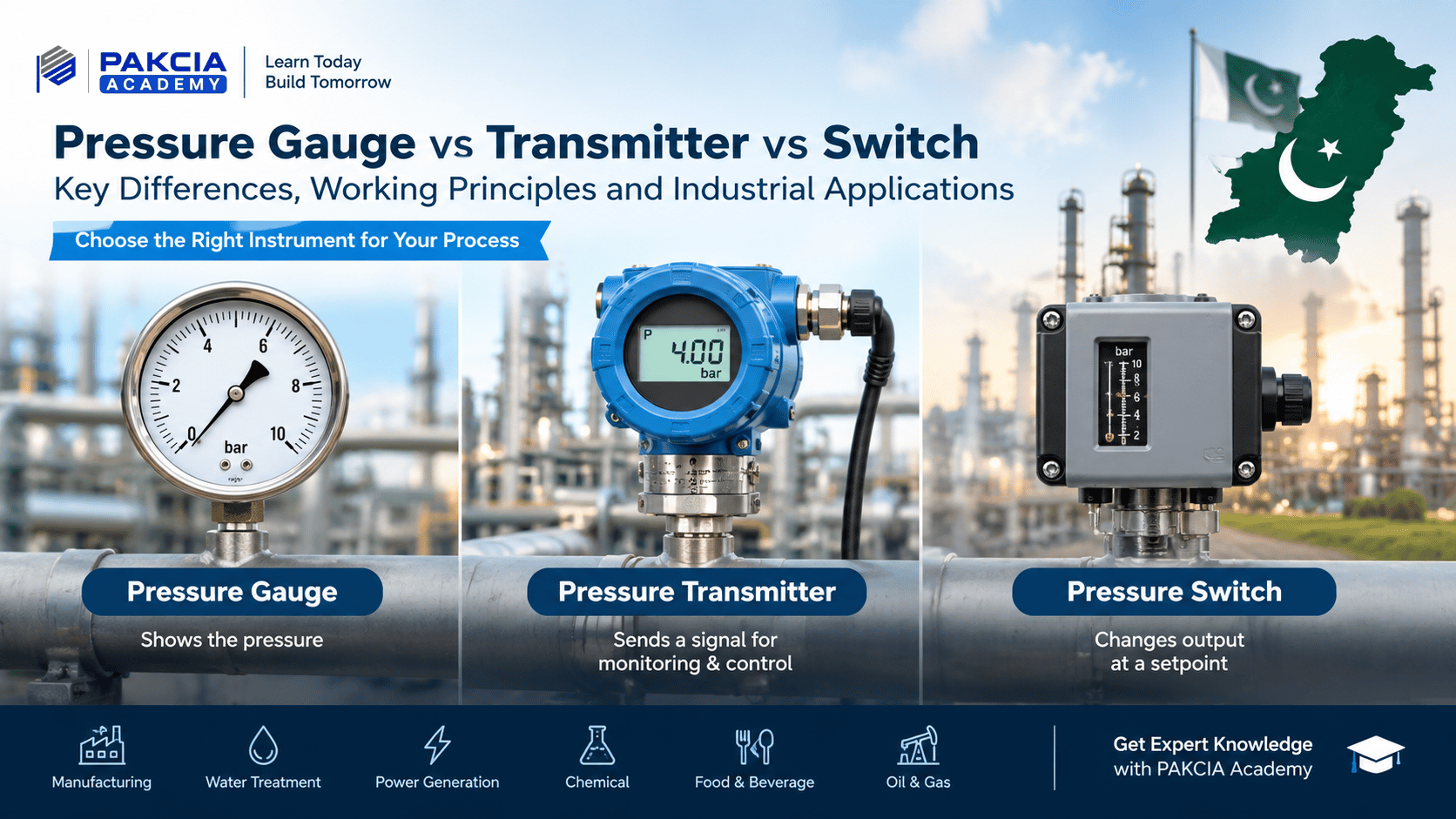
Although all three instruments can be used to monitor pressure, they do not perform exactly the same function. A pressure gauge provides a local reading, a pressure transmitter converts measured pressure into an electrical signal for monitoring and control systems, and a pressure switch changes its output state when pressure reaches a specified setpoint.
Understanding these differences is essential for instrumentation engineers, electrical engineers, maintenance technicians, DAE students and industrial professionals working in Pakistan's manufacturing, water treatment, pharmaceutical, food processing, chemical, power generation and oil and gas sectors.
In this guide, we explain how each instrument works, where it is used, how the three devices compare, and what you should consider when selecting the right pressure measurement solution.
1. What Is a Pressure Gauge?
A pressure gauge is an instrument used to display the pressure of a liquid or gas. Most conventional industrial pressure gauges provide a direct visual reading through a dial and pointer, allowing an operator or technician to check process pressure without needing a PLC, DCS or separate electronic display.
Pressure gauges are widely used because they are simple to understand, practical for routine inspections and available in many pressure ranges and configurations.
How Does a Pressure Gauge Work?
A common industrial pressure gauge uses a Bourdon tube. When pressurized fluid enters the tube, the curved tube tends to straighten slightly. A mechanical linkage transfers this movement to a pointer, which indicates the pressure on a calibrated dial.
Other pressure gauges use diaphragms or capsule elements, depending on the pressure range, medium and application.
For example, a gauge installed on a water pump discharge line may show a pressure reading of 4 bar. An operator can compare this reading with the normal operating range to determine whether the pump is operating as expected.
Common Types of Pressure Gauges
- Bourdon tube pressure gauge: Frequently used for general industrial pressure measurement, including pumps, compressors, pipelines and hydraulic equipment.
- Diaphragm pressure gauge: Uses a flexible diaphragm to respond to pressure. It can be suitable for particular low-pressure, corrosive or process applications when the instrument materials and design are appropriate.
- Differential pressure gauge: Measures the pressure difference between two points. It can be used to monitor filter blockage, pressure drop across equipment and other differential-pressure applications.
- Digital pressure gauge: Uses electronic sensing and a digital display to show the measured pressure. Some models offer additional functions such as peak-value recording or selectable units.
Where Are Pressure Gauges Used in Pakistan?
Typical applications include:
- Water supply and water treatment plants
- Air compressors and compressed-air systems
- Hydraulic power packs
- Boiler and steam systems, with gauges suitable for the specified service
- Industrial pumps and pipelines
- Manufacturing plants and maintenance workshops
A pressure gauge is often the right choice when personnel need a clear, local indication of pressure and do not require a continuous electronic signal from that measurement point.
However, a conventional mechanical gauge does not automatically send a continuous pressure value to a control room. If remote monitoring, trending or automatic control is required, an electronic instrument may be necessary.
2. What Is a Pressure Transmitter?
A pressure transmitter is an electronic instrument that measures pressure and converts it into a standardized electrical or digital output that can be received by a monitoring or control system.
Unlike a conventional mechanical pressure gauge, a transmitter can communicate pressure information to equipment such as a programmable logic controller (PLC), distributed control system (DCS), remote I/O module, data logger or compatible monitoring system.
Pressure transmitters are particularly useful when a process must be monitored continuously or controlled automatically.
How Does a Pressure Transmitter Work?
A pressure transmitter typically contains a pressure-sensitive element, signal-conditioning electronics and an output interface.
The sensing element responds to applied pressure. Internal electronics convert that response into a usable output signal. Depending on the transmitter, the output may be an analog signal, such as 4–20 mA, a voltage signal or a digital communication protocol.
For example, a transmitter configured for a pressure range of 0–10 bar may be connected to a PLC through a 4–20 mA input.
- 0 bar corresponds to 4 mA.
- 5 bar corresponds to 12 mA.
- 10 bar corresponds to 20 mA.
The PLC scales the measured current into engineering units, allowing operators to view the pressure on an HMI or SCADA screen. These values are illustrative. The actual range, output and scaling must match the instrument configuration and control-system setup.
What Is a 4–20 mA Pressure Transmitter?
The 4–20 mA signal is widely used in industrial process instrumentation because it can transmit a measurement over suitable wiring and helps distinguish a valid low-end measurement from a zero-current condition that may indicate a wiring or power problem.
A 4–20 mA signal does not mean that every transmitter measures the same pressure range. One instrument may be configured for 0–6 bar, while another may measure 0–100 bar. The control system must use the correct range and scaling for the selected instrument.
Common Types of Pressure Transmitters
- Gauge pressure transmitter: Measures pressure relative to local atmospheric pressure.
- Absolute pressure transmitter: Measures pressure relative to a vacuum reference. It is useful where absolute pressure is important to the process.
- Differential pressure transmitter: Measures the difference between two pressure inputs. Applications include filter monitoring, flow measurement using a suitable primary element, and liquid-level measurement in appropriate tank configurations.
- Smart pressure transmitter: May provide configuration, diagnostic and communication functions beyond a basic analog output, depending on its design and protocol.
Where Are Pressure Transmitters Used?
Pressure transmitters are commonly used in:
- Automated process plants
- Pump and compressor monitoring
- Water and wastewater treatment
- Chemical and pharmaceutical production
- Food and beverage processing
- Pressure control loops
- Remote monitoring and data acquisition
A pressure transmitter is a suitable choice when pressure must be continuously measured and made available to a control or monitoring system.
It is important to distinguish the transmitter's measurement function from the controller's function. A transmitter measures and reports pressure; a PLC, DCS or other controller may use that value to regulate a valve, adjust a pump or generate an alarm.
3. What Is a Pressure Switch?
A pressure switch is an instrument that changes the state of an electrical output when pressure reaches a configured switching point.
Instead of continuously communicating the complete pressure value as its primary output, a conventional pressure switch provides a discrete state, such as ON/OFF or open/closed. Depending on the design, it may use mechanical contacts or electronic switching outputs.
Pressure switches are commonly used to initiate actions when pressure becomes too high or too low.
How Does a Pressure Switch Work?
A pressure switch contains a pressure-responsive element and a switching mechanism or electronic circuit.
When the measured pressure reaches the configured setpoint, the switch changes its output state. That signal can be used to activate an alarm, start or stop equipment, or provide an input to a control system.
For example, a water pumping system may use a pressure switch to start a pump when pressure falls below a lower setpoint and stop it when pressure reaches an upper setpoint. Whether this arrangement is appropriate depends on the system design, switching differential, pump requirements and protection provisions.
Many pressure switches use separate switching and reset points, or a defined switching differential, to prevent rapid repeated switching around a single threshold.
Common Types of Pressure Switches
- Mechanical pressure switch: Uses a pressure-responsive mechanical element and electrical contacts to change circuit state.
- Electronic pressure switch: Uses electronic sensing and switching electronics. Depending on the model, it may include a digital display, adjustable switching points and additional outputs.
- Differential pressure switch: Responds to the difference between two pressures. It can be used for applications such as monitoring a filter's pressure drop.
- Vacuum pressure switch: Detects pressure conditions within a specified vacuum range.
Where Are Pressure Switches Used?
- Pump control systems
- Air compressors
- Hydraulic power units
- Low-pressure and high-pressure alarms
- Filter and differential-pressure monitoring
- Equipment protection and interlocking circuits
A pressure switch is appropriate when the required action depends on a threshold being reached rather than on the continuous value of the pressure.
Important safety note: A standard pressure switch should not automatically be treated as a certified safety instrument. Applications involving hazardous pressure, boilers, critical machinery or personnel protection require an appropriately engineered and rated protection system.
4. Pressure Gauge vs Pressure Transmitter vs Pressure Switch: Key Differences
The most important difference is what each instrument provides to the operator or control system.
| Feature | Pressure Gauge | Pressure Transmitter | Pressure Switch |
|---|---|---|---|
| Primary function | Local pressure indication | Continuous pressure measurement and signal output | Switching at a pressure threshold |
| Typical output | Dial or digital display | Analog or digital measurement signal | Discrete switching output |
| Typical user | Operator or maintenance technician | PLC, DCS, SCADA or monitoring system | Relay circuit, PLC or alarm system |
| Continuous pressure value | Visible locally on many models | Yes, within configured range and capabilities | Not necessarily; depends on model |
| Automatic control | Not by itself in a conventional design | Supplies measurement for a controller | Can trigger a configured action |
| Typical application | Routine pressure checks | Monitoring, trending and closed-loop control | High/low pressure detection |
| Main selection concern | Range, readability and compatibility | Range, accuracy, output and process compatibility | Setpoint, switching differential and output rating |
These are general distinctions. Some products combine functions—for example, a pressure gauge with electrical contacts or an electronic pressure switch with a display and an additional analog output. Always check the exact model's datasheet.
A Simple Way to Remember the Difference
- Pressure gauge: Shows the pressure.
- Pressure transmitter: Sends the measured pressure to another system.
- Pressure switch: Changes an output when pressure reaches a threshold.
The devices may all be used on the same process, but each serves a different purpose.
5. Practical Industrial Example: Monitoring a Water Pump
Consider a water pumping station in a Pakistani industrial facility.
The engineering team wants to see the discharge pressure locally, monitor the pressure from a control room and receive a warning if the pressure falls below an acceptable level.
A possible arrangement is:
1. Pressure gauge: Installed at a suitable point on the discharge line so a technician can visually check the pressure during inspection.
2. Pressure transmitter: Connected to a compatible PLC or monitoring system so operators can observe pressure remotely, review trends and use the measurement in a control strategy.
3. Pressure switch: Configured to provide a discrete low-pressure signal or initiate an appropriate control action, according to the approved system design.
Using all three instruments may be justified when local indication, continuous monitoring and threshold-based action are all required. However, they are not automatically needed together on every pump. The final arrangement depends on the operating requirements, risk assessment, existing control system and applicable standards.
The same principle applies to compressors, hydraulic systems, water treatment plants and other industrial processes: choose instruments according to the function required, rather than selecting them simply because they measure pressure.
6. How to Choose the Right Pressure Measurement Instrument
Selecting an instrument requires more than checking the maximum pressure shown on its dial or datasheet.
Step 1: Define the Purpose
Ask what the system actually needs.
- For local visual inspection, consider a pressure gauge.
- For continuous remote monitoring, consider a pressure transmitter.
- For a discrete action at a defined pressure threshold, consider a pressure switch.
If more than one function is required, a combination instrument or separate devices may be appropriate.
Step 2: Select the Correct Pressure Range
The measuring range should suit the normal operating pressure and expected process conditions. Avoid selecting a range based only on the highest number that appears on an existing instrument.
Consider normal pressure, maximum expected pressure, pressure surges and the manufacturer's specified limits. For cyclic or pulsating pressure, the instrument may require additional protection or a design suited to those conditions.
Step 3: Confirm the Pressure Reference
Determine whether the application requires gauge pressure, absolute pressure or differential pressure.
These measurements are not interchangeable. For example, a transmitter measuring differential pressure across a filter must be selected and connected differently from a transmitter measuring the gauge pressure in a pipeline.
Step 4: Check Process Compatibility
Confirm the process medium, wetted materials, temperature, corrosion risk, cleanliness requirements and any need for a diaphragm seal or other process connection.
For steam, aggressive chemicals, viscous fluids or sanitary applications, the instrument and installation must be suitable for the actual service conditions.
Step 5: Check the Output and Control-System Requirements
For transmitters, confirm signal type, supply requirements, wiring, electrical protection and compatibility with the PLC or DCS input.
For pressure switches, check contact or output type, switching current and voltage, switching differential, setpoint adjustability and reset behaviour.
For gauges, check dial size, connection type, mounting arrangement, accuracy class and readability.
Step 6: Consider Installation and Maintenance
Select suitable process connections, isolation arrangements and installation accessories. Ensure instruments can be inspected and calibrated safely.
A correct instrument can still provide unreliable readings if it is installed incorrectly, exposed to unsuitable conditions or maintained poorly.
7. Why Learn WIKA Pressure Measurement?
WIKA is an established manufacturer of pressure measurement instruments, including pressure gauges, pressure sensors, transmitters and switches. Its product portfolio covers different measurement principles and applications.
For engineers, technicians and industrial sales professionals, understanding the differences between these instrument types makes it easier to interpret datasheets, compare specifications and discuss suitable solutions with customers and maintenance teams.
If you want to build your knowledge step by step, PAKCIA Academy offers Urdu audio learning resources focused on pressure measurement.
Start with the Fundamentals
Explore the Pressure Measurement Basics Audio Course in Urdu. This is a useful starting point for learners who want to develop their understanding of pressure measurement principles before studying specialist products.
Go Deeper into WIKA Products
If your work involves WIKA instruments, explore the WIKA Pressure Measurement Audio Course in Urdu. It is designed for learners who want to study WIKA pressure measurement products and develop more product-specific knowledge.
These courses are educational resources. Always refer to the relevant manufacturer's datasheet, installation instructions and applicable standards when selecting, installing, configuring or maintaining an actual industrial instrument.
8. Frequently Asked Questions
What Is the Main Difference Between a Pressure Gauge and a Pressure Transmitter?
A conventional pressure gauge displays pressure locally, usually through a dial and pointer. A pressure transmitter converts the measured pressure into an electrical or digital signal that can be used by a compatible monitoring or control system.
What Is the Difference Between a Pressure Switch and a Pressure Transmitter?
A pressure transmitter normally provides a continuous measurement signal representing the pressure. A pressure switch changes its output state when the pressure reaches a configured switching point. Some electronic pressure switches also provide a display or additional measurement output, depending on the model.
Can a Pressure Transmitter Replace a Pressure Gauge?
A transmitter can provide remote pressure monitoring, but it does not automatically replace the need for local indication. Whether a separate gauge is required depends on the application, operating procedures, engineering design and applicable requirements.
Can a Pressure Switch Control a Water Pump?
Yes. A suitably selected and configured pressure switch can be used in a pump-control arrangement. The switching points, differential, electrical ratings and pump-control design must be appropriate for the system.
What Does 4–20 mA Mean in Pressure Measurement?
It is a common analog signal range used by industrial transmitters. In a typical linear configuration, 4 mA represents the lower range value and 20 mA represents the upper range value. The receiver must be configured for the transmitter's actual measuring range.
Which Pressure Measurement Instrument Is Best for Pakistani Industries?
There is no single best instrument for every application. A gauge is often suitable for local indication, a transmitter for continuous remote measurement and a switch for threshold-based actions. The correct choice depends on the process, required function, operating conditions, control system and safety requirements.
Where Can I Learn Pressure Measurement in Urdu?
You can start with the Pressure Measurement Basics Audio Course in Urdu at PAKCIA Academy. Learners seeking more product-specific knowledge can explore the WIKA Pressure Measurement Audio Course in Urdu.
Conclusion
Pressure gauges, pressure transmitters and pressure switches all play important roles in industrial pressure measurement, but they serve different purposes.
A pressure gauge provides local indication. A pressure transmitter supplies a continuous measurement signal for remote monitoring and control. A pressure switch changes its output state when pressure reaches a configured threshold.
Understanding these distinctions helps engineers and technicians select suitable instruments, troubleshoot systems more effectively and communicate more confidently about industrial instrumentation.
For Pakistani students and professionals who want to strengthen their technical knowledge, structured learning is a useful starting point. Explore PAKCIA Academy's Pressure Measurement Basics Audio Course in Urdu or advance to the WIKA Pressure Measurement Audio Course in Urdu to continue learning about pressure measurement principles and products.
Recommended products

Share this article: